
The Caribbean pirate has become one of history’s most recognizable characters: a swaggering outlaw with a cutlass, treasure map, and perhaps a parrot on his shoulder. Real piracy was less romantic—and often far more disturbing. The pirates who hunted ships across the Caribbean operated within a violent world shaped by imperial rivalry, global commerce, slavery, and naval warfare.
During the Golden Age of Piracy, pirate crews attacked merchant vessels, raided ports, occupied temporary strongholds, and sometimes disrupted entire trade routes. Historians use different dates for this period, but it is generally associated with the late seventeenth and early eighteenth centuries, when piracy surged across the Caribbean, North America’s Atlantic coast, West Africa, and the Indian Ocean.
The Pirates of the Caribbean is a successful movie franchise and popular ride at Disney World. But the story of the real pirates is even more interesting, and more violent, albeit with a few less ghosts in the mix. So grab a bottle of rum, raise the Jolly Roger, and sit back for a historical telling that needs no embellishments. ARGH, matey!
Pirate or Privateer?
The boundary separating a pirate from a legal sea raider could be surprisingly thin.
A pirate attacked ships without government authority. A privateer, however, carried a commission called a letter of marque. During wartime, this document permitted a privately owned ship to capture vessels belonging to an enemy nation and share in the profits.
European governments used privateers because they were less expensive than maintaining enormous navies. In the seventeenth-century Caribbean, England and France encouraged attacks against Spanish ships and settlements. These raids weakened Spain while enriching rival colonies.
The arrangement created an obvious problem. Once sailors had learned to seize ships for profit, they did not always stop when peace returned. Privateering became piracy when captains exceeded their commissions, attacked neutral vessels, or continued raiding after a war ended.
Unit 1 · The Ocean’s Logbook
Sailing the Gyre
A square-rigged ship cannot sail into the wind, and the ocean is moving underneath it. Plan a crossing that works with both — then find out why every homebound treasure fleet had to squeeze through the same narrow gap.
Sailing orders
Chart overlays
Plot your course
Log
The Buccaneers of the Caribbean
The earliest famous Caribbean pirates were the buccaneers. Their name developed from boucan, a wooden frame used for smoking meat. Many began as hunters on Hispaniola and Tortuga before turning to maritime raiding.
From approximately 1650 to 1680, French, English, and Dutch buccaneers attacked Spanish ships and coastal settlements. Important bases included Tortuga, off Hispaniola, and Port Royal, Jamaica, where merchants and colonial officials benefited from captured goods.
The best-known buccaneer was Henry Morgan, a Welsh privateer who led major attacks against Spanish possessions. His forces captured Portobelo in 1668 and attacked Panama in 1671. Morgan was later knighted and became lieutenant governor of Jamaica—an extraordinary transformation from raider to colonial official.
The Pirate Round and a Wider Ocean
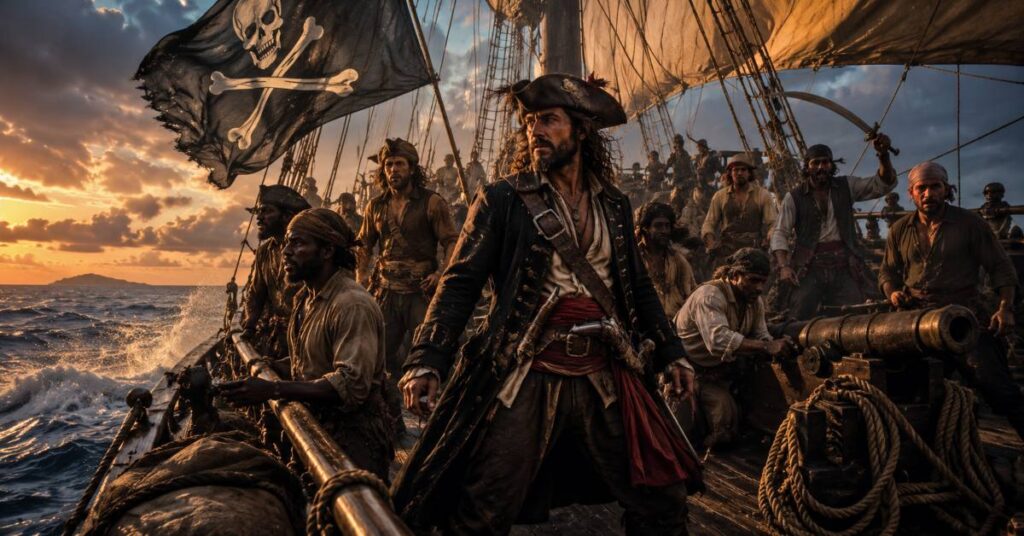
By the 1690s, some pirates were looking beyond the increasingly defended Caribbean. They followed a route later called the Pirate Round, sailing from North American ports around the Cape of Good Hope and into the Indian Ocean.
There they targeted ships carrying valuable goods between India, the Red Sea, and Europe. In 1695, Henry Every, also known as Henry Avery, captured the Mughal treasure ship Ganj-i-Sawai. The enormous robbery triggered an international search for Every and his crew, but the captain disappeared.
The episode reveals that Caribbean piracy belonged to a much larger maritime network. Pirates moved among the Americas, Africa, and Asia, following trade routes wherever valuable cargoes and weak defenses created opportunities.
Nassau and the Pirate Republic
The most famous phase began after the War of the Spanish Succession ended in 1713. Thousands of privateers and sailors suddenly lost their wartime employment. Some turned to piracy, producing the generation remembered in popular culture: Blackbeard, Charles Vane, “Calico Jack” Rackham, Anne Bonny, Mary Read, and Bartholomew Roberts.
Many gathered at Nassau on New Providence Island in the Bahamas. With little effective government, Nassau became a refuge where crews repaired vessels, sold stolen goods, recruited sailors, and planned new voyages. It is often called a “Pirate Republic,” although it was less an organized nation than a loosely controlled settlement dominated by competing captains.
Its location was ideal. Nassau stood close to major shipping routes and was surrounded by shallow waters that large naval ships found difficult to navigate.
The Gulf Stream: An Ocean Highway—and a Pirate Trap
The Caribbean’s pirates benefited from understanding the same ocean currents used by Spanish navigators. Treasure ships carrying silver, gold, and other colonial goods commonly assembled at Havana before beginning the return voyage to Spain. From there, they entered the Straits of Florida, where the powerful northward-flowing Florida Current carried them between Florida and the Bahamas and into the Gulf Stream.
As part of the clockwise North Atlantic subtropical gyre, this warm western boundary current helped ships move northward before they turned east across the Atlantic toward Europe. It was one of the most important maritime highways of the colonial world.
The route’s predictability also made it dangerous. Pirates and privateers knew that heavily laden Spanish ships had to pass through narrow channels near Cuba, the Bahamas, and the Florida Keys. Rather than searching an entire ocean, raiders could patrol these natural chokepoints and wait for merchant vessels to appear.
The shallow Bahama banks, nearby islands, reefs, and concealed anchorages also favored fast pirate sloops that could maneuver where large warships could not. In this way, the Gulf Stream did more than move seawater: it concentrated trade, treasure, and piracy along the same narrow corridor.
Life Under the Pirate Code
Pirates were violent, but their ships were not necessarily chaotic. Many crews followed written agreements called articles. These established how treasure would be divided, what conduct was forbidden, and how decisions would be made.
Common provisions included:
- Captains chosen—or removed—by the crew
- An elected quartermaster who represented crew interests
- Agreed shares of captured goods
- Rules against stealing from shipmates or fighting aboard ship
- Compensation for severe injuries suffered in battle
These practices could appear remarkably democratic compared with the harsh discipline of merchant vessels and national navies. Captains usually received a larger share of treasure, but not the enormous portion claimed by many merchant captains. Some articles also provided specific payments for the loss of an arm, leg, or eye.
Pirate society should not, however, be romanticized as universally fair. Pirates robbed, tortured, and killed, and they operated within economies built on colonial exploitation and slavery.
Pirate crews could be ethnically diverse, and some Black sailors served as armed crew members. Yet pirates also captured, sold, and exploited enslaved people. Their limited shipboard equality existed alongside extreme violence and oppression.
How Pirates Captured Ships
Pirates usually preferred surrender to a destructive cannon battle. A damaged prize meant ruined cargo, wounded crew members, and costly repairs. Their most effective weapon was often fear.
A pirate vessel might approach under a false national flag, then raise a black flag once escape became difficult. Designs featuring skulls, skeletons, weapons, or hourglasses reminded victims of death. A red flag could signal that resistance would be met without mercy, although flag designs and meanings varied among crews.
Pirates favored fast, maneuverable vessels such as sloops. Their shallow draft allowed them to cross sandbars, enter narrow channels, and escape heavier warships. They also carried unusually large crews, creating an advantage during boarding.
When force was necessary, pirates tried to disable rather than sink a target. Chain shot and bar shot tore through sails and rigging, while grapeshot swept exposed decks. Pirates then used grappling hooks to pull the ships together and boarded with cutlasses, muskets, pistols, and grenades.
Blackbeard: Terror as a Strategy
No pirate used reputation more effectively than Edward Thatch, better known as Blackbeard. His surname appears with several spellings in historical records, and much of his early life remains uncertain.
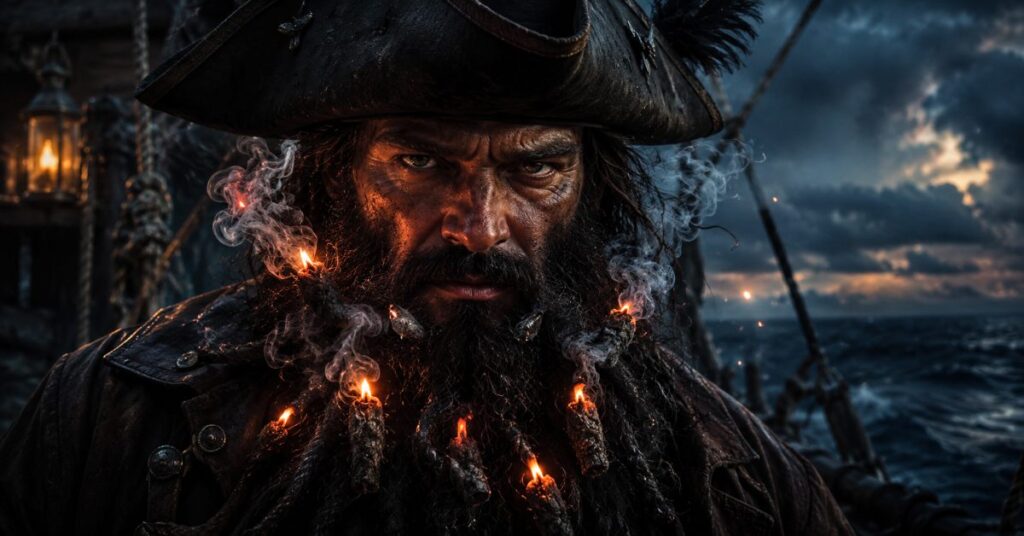
In 1717, Blackbeard captured the French slave ship La Concorde, renamed it Queen Anne’s Revenge, and converted it into his flagship. Accounts describe him placing slow-burning cords of hemp beneath his hat and woven into his beard so that the embers glowed and smoke surrounded his face during an attack. Some details may have been exaggerated, but the purpose was clear: terrified crews were more likely to surrender without fighting.
After Queen Anne’s Revenge ran aground near Beaufort, North Carolina, Blackbeard continued operating from a smaller vessel. He was killed at Ocracoke Inlet on November 22, 1718, by a force led by Royal Navy Lieutenant Robert Maynard.
The End of the Golden Age
Piracy eventually became too disruptive for European empires to tolerate. Governments offered pardons to pirates willing to surrender while sending naval forces after those who refused. Woodes Rogers arrived in the Bahamas as royal governor in 1718 and helped restore British authority over Nassau.
The pirate leaders fell quickly. Blackbeard died in 1718, while Bartholomew Roberts was killed off West Africa in 1722. Captured crews faced public trials, hangings, and sometimes display in iron cages as warnings to others.
By the late 1720s, stronger navies, harsher prosecutions, improved colonial government, and fewer safe harbors had brought the great Atlantic surge of piracy to an end.
Myth, Memory, and the Real Pirates
Buried treasure, walking the plank, and comic pirate speech owe more to novels and movies than to ordinary pirate life. Most stolen cargo consisted of practical goods such as cloth, sugar, tobacco, food, medicine, weapons, and occasionally coins or precious objects.
The real pirates of the Caribbean were neither lovable rebels nor simple monsters. They were products of an Atlantic world shaped by war, commerce, poverty, empire, and slavery. Their brief reign exposed weaknesses in colonial governments and global shipping—and their carefully constructed legends still sail through popular culture three centuries later.