
Sharks get the headlines, but the real danger at the beach is usually the water itself. The United States Lifesaving Association estimates that rip currents kill more than 100 people a year on U.S. beaches, and that rip currents are involved in over 80% of rescues by surf beach lifeguards. Fatal shark bites in the U.S., by comparison, average fewer than one a year. WFSU News
Rip Watch is a free, browser-based game to help teach rip current safety. In three chapters, players learn to spot a rip current from the lifeguard stand, survive one from inside the water, and then take a shift as the lifeguard on duty. It’s part learning, part video game, and it works on laptops, Chromebooks, and phones with nothing to install.
Beach warning flags
How Rip Watch works
Chapter 1: Spot the Rip. Players climb the lifeguard stand and scan six beaches for rip currents. The rips are animated to behave like real ones: waves stop breaking in the channel, foam streams back out to sea, and the water looks darker and calmer. Later beaches add decoys, like cloud shadows, patches of rock and seaweed, and random lulls in the waves, so players learn to watch the water rather than click the first gap they see. Two beaches end with a decision: where would you swim, given the flag and the rips you just found?
Chapter 2: Break the Grip. Now you’re in the water, caught in a rip. From a top-down view, players steer a swimmer while managing energy and calm. Swimming straight at the beach against a strong current turns into a treadmill. Swimming sideways, floating, and waving for help each work in some situations and fail in others. Five levels feature different kinds of rips, including one that flows in a loop and one that runs alongside a pier. After each attempt, a replay shows the swimmer’s path over the current, so players see exactly why their choice worked.
Chapter 3: Lifeguard Shift. Players become the lifeguard. Using binoculars to scan a crowded beach, they whistle swimmers away from danger, launch rescues, decide who needs help first, and raise the red flag when the surf builds. The key challenge: telling kids splashing for fun from a swimmer in real trouble. The chapter ends with a bystander scenario. It’s your day off, there’s no lifeguard, and your friend is caught in a rip. What do you do?
What students learn
By the end of Rip Watch, players can identify rip currents from shore using several clues together, explain why swimming straight toward shore against a rip fails, and choose between swimming parallel, floating, and signaling for help. They also learn that drowning is usually quiet, that lifeguards prevent far more emergencies than they rescue, and that the safest way to help someone caught in a rip is from the beach.
Chapter 2 also gives students a hands-on feel for vector addition. The path a swimmer actually takes is their own swimming speed and direction combined with the current’s, and an optional arrow display makes that visible in real time.
Rip Current Safety
Rip currents: the beach’s biggest hidden danger
Rip currents are a year-round hazard anywhere waves break, and Florida sees more than its share. According to the National Weather Service office in Melbourne, rip currents kill more people in Florida, on average, than hurricanes, tornadoes, and lightning combined. In 2023, the NWS counted 30 rip current deaths in Florida, with Panama City Beach recording more drownings than anywhere else in the country.
In South Florida, rip current deaths happen most often during spring break in March and April, over the summer, and on major holiday weekends. Most victims are people unfamiliar with surf, including tourists and Floridians who live inland, though locals are sometimes caught too.
The good news is that awareness saves lives. The NWS Miami office credits a long-term drop in South Florida rip current deaths to greater public awareness, ocean rescue lifeguards, and more warning signs and flags at local beaches. weather
What is a rip current?
A rip current is a narrow, fast-moving channel of water flowing away from the beach. As waves break, they push water toward shore. That water has to return to the ocean, and it tends to funnel back out through the easiest path: a low spot or gap in a sandbar, or the area alongside a pier or jetty.
Rip currents are sometimes called “rip tides” or “undertow,” but both names are misleading. Rips have nothing to do with tides, and they don’t pull you under the water. They pull you away from shore. The danger comes from what happens next: a swimmer panics, tries to swim straight back against the current, and wears out.
Most rip currents move at 1 to 2 feet per second, but strong ones have been measured at up to 8 feet per second. That’s faster than an Olympic swimmer, so no one can reliably out-swim a strong rip by heading straight for the beach.
Rip Current Safety: How to spot a rip current
Rip currents can be hard to see, but a few clues give them away:
- A gap in the line of breaking waves, where the water looks calmer.
- A channel of darker water, because the channel is deeper.
- Foam, seaweed, or sediment moving steadily away from shore.
- A choppy, churning strip of water between smoother areas.
No single clue is proof. Dark water can be a cloud shadow or rocks on the bottom, and waves sometimes skip breaking for a moment. The most reliable test is to watch for a few minutes before you go in: a real rip’s gap stays open wave after wave.
The best protection of all is simple. Swim at a beach with lifeguards, stay near the stand, and check the flag before you get in the water.
What to do if you’re caught in a rip current
First, stay calm. The current will pull you away from shore, but it won’t pull you under. Don’t try to swim straight back to the beach against it.
From there, you have options:
- Swim parallel to the shore. Most rips are narrow, so swimming sideways can get you out of the pull. Once you’re free, angle back toward the beach.
- Float or tread water. Floating saves energy. Many rips circulate within the surf zone and can carry a floating swimmer back toward shallow water.
- Face the shore, wave, and yell for help. If you’re tired or unsure you can make it, draw attention to yourself.
Why more than one option? Research on real rip currents shows that no single strategy works every time. Swimming parallel can fail if you swim against the current feeding the rip, and floating can carry you past the breakers if the rip flows straight out to sea. That’s why Rip Watch gives players different kinds of rips and lets them discover which strategy fits each one.
What drowning really looks like
Many people expect drowning to look like it does in movies: loud splashing, waving, and shouting. The reality is very different. When someone is drowning, there is very little splashing, and there is usually no waving, yelling, or calling for help. Alden 44
Dr. Francesco Pia, a former lifeguard, named this the instinctive drowning response. A drowning person’s mouth keeps sinking below the surface and coming back up, so they can’t breathe long enough to call out. Instead of waving, their arms reach out to the sides and press down on the water. Their body stays upright, their head tilts back, and they typically struggle at the surface for no longer than 20 to 60 seconds before going under.
A swimmer who is yelling and thrashing is also in real trouble. That stage is called aquatic distress. It doesn’t last long, but unlike true drowning, those swimmers can still help in their own rescue. The quiet swimmer with their head back is in more danger. Chapter 3 of Rip Watch trains players to tell the difference.
How to help someone caught in a rip current
If a lifeguard is on duty, alert them right away. If not:
- Call 911 and send someone to look for help.
- Throw something that floats, such as a boogie board, cooler, life jacket, or beach ball.
- Yell instructions: swim parallel to the beach, or float and wave.
Do not swim out after them, and never form a human chain into the water. Would-be rescuers often become victims themselves. Staying on the beach and getting help coming is the bravest and most useful thing you can do.
Lifeguards: prevention first
A lifeguard’s most important work often happens before anyone is in trouble. In 2024, USLA-reporting lifeguard agencies recorded 85,258 rescues and 22,847,774 preventive actions, such as warning swimmers away from rip currents and moving people to safer water. That’s hundreds of warnings for every rescue, and it’s why swimming near a lifeguard is one of the best safety choices you can make.
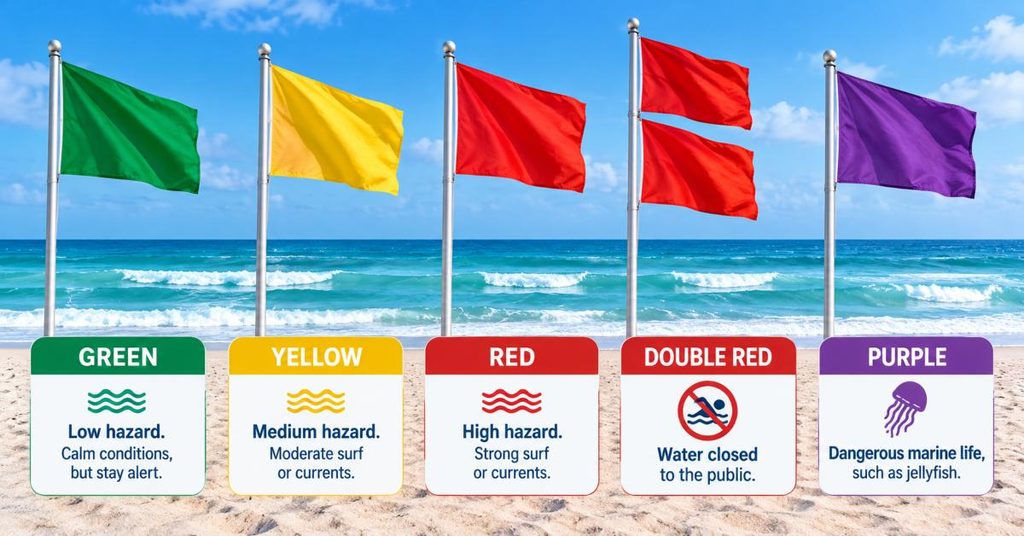
Beach warning flags
Florida beaches use a standard set of warning flags:
- Green: Low hazard. Calm conditions, but stay alert.
- Yellow: Medium hazard. Moderate surf or currents.
- Red: High hazard. Strong surf or currents.
- Double red: Water closed to the public.
- Purple: Dangerous marine life, such as jellyfish.
A green flag doesn’t mean there are no rip currents. Rips can form on calm days too, so keep watching the water whatever the flag says.
Rip Current Safety – Frequently asked questions
Is a rip current the same as a rip tide or undertow?
No. Rip currents aren’t caused by tides, and they don’t drag you under. They pull you away from shore through a narrow channel.
How fast can a rip current move?
Most move at 1 to 2 feet per second, but strong rips can reach 8 feet per second, faster than an Olympic swimmer.
Can a rip current happen on a calm, sunny day?
Yes. Rip currents can form any time waves are breaking, including under a green flag.
Should I swim parallel or float if I’m caught?
Both are recommended, and each works better in different situations. Stay calm, don’t fight the current head-on, and if you’re tiring, float and signal for help.
Sources
National Weather Service and NOAA rip current safety guidance; United States Lifesaving Association statistics; NWS Melbourne, East Central Florida Rip Current Fact Sheet; NWS Miami, Marine Hazards and Rip Current Awareness; Francesco A. Pia, Ph.D., “Drowning Doesn’t Look Like Drowning,” U.S. Coast Guard On Scene magazine, Fall 2006; CPALMS course description for Marine Science 1 Honors (2002510).