
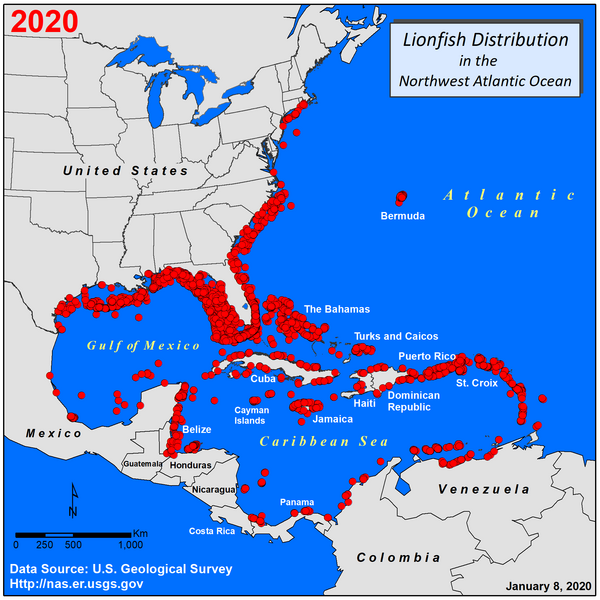
Lionfish are beautiful, venomous, and completely out of place on Florida’s reefs, where the coastal waters, warmed by the Gulf Stream Currents, provide an inviting new home. The first lionfish recorded in the western Atlantic was caught near Dania, Florida in 1985, most likely released from a home aquarium, or from the ballast of a visiting cargo ship. Today they’re established from the Gulf to North Carolina, and they have no consistent predators in their invaded range while preying on more than 90 different marine species. (Source: Manatee Lagoon)
But controlling invasive lionfish is a huge challenge. Divers fight back with derbies: one-day competitions where teams compete to remove as many lionfish as they can. Derby Day puts students on that boat. It’s a free browser game with three timed dives, a reef report after each one, and an ending that asks a harder question: can we ever actually win?
Fish ID guide
How Derby Day works
Players take three dives in one derby day, swimming a reef with a pole spear and a containment tube:
Dive 1, the patch reef. Shallow water and lionfish hovering in the open. Lionfish don’t flee, which makes them easy to approach and is exactly why spearing works.
Dive 2, ledges and a wreck. Half the lionfish hide under rock overhangs and inside a sunken ship. Players switch on a dive light to see into the shadows, on a battery that runs down. Spear into the dark without looking first and the game stops you, because you can’t tell what’s under there. Moray eels are hiding in the same holes.
Dive 3, the reef edge. The reef slopes from 45 feet to 100 feet and then drops off. The biggest lionfish are deepest, but air runs out much faster down there.
Three things create the pressure: a tank of air, a tube that holds only ten fish, and three rival boats climbing the leaderboard beside you. Air use follows real diving physics, running down about four times faster at 99 feet than at the surface, so students feel the depth tradeoff rather than just reading about it. Run the tank dry and you make an emergency ascent and lose the fish in your tube.
Only lionfish count. Spearing a native fish costs points and hurts the reef, and each mistake explains itself. The trickiest is the spotted scorpionfish, a native that sits camouflaged on the bottom and gets mistaken for a lionfish all the time. A built-in fish ID guide shows the differences. Brush against a lionfish and you take a sting, with a reminder that the spines are venomous but the meat is not.
What students learn
After each dive, a reef report shows what the removals actually did: how many lionfish were left on that reef, how many young native fish would settle there over the next five weeks compared with an untouched reef, and roughly how many eggs were prevented.
Then comes the ending. A sonar scan below the reef edge finds lionfish deeper than any recreational diver can reach, with larvae drifting up to resettle the reef that was just cleared. Lionfish reach their greatest densities below about 75 feet and can live as deep as 1,000 feet, far beyond a diver’s limit. Students win the derby and still learn the real lesson: removal suppresses lionfish locally, but it can’t eradicate them. Manatee Lagoon
The weigh-in awards places for most, largest, and smallest lionfish against the rival teams, and closes with the strategy that keeps divers in the water: eat them.
Lionfish Impact on Ecosystem
Lionfish belong in the Indo-Pacific and the Red Sea. In the Atlantic, almost everything about them works in their favor.
They breed constantly. Females mature in under a year, and mature females release about 50,000 eggs every three days, year round, for the rest of their lives, while most reef fish spawn only once a year. That adds up to more than two million eggs a year from a single female.
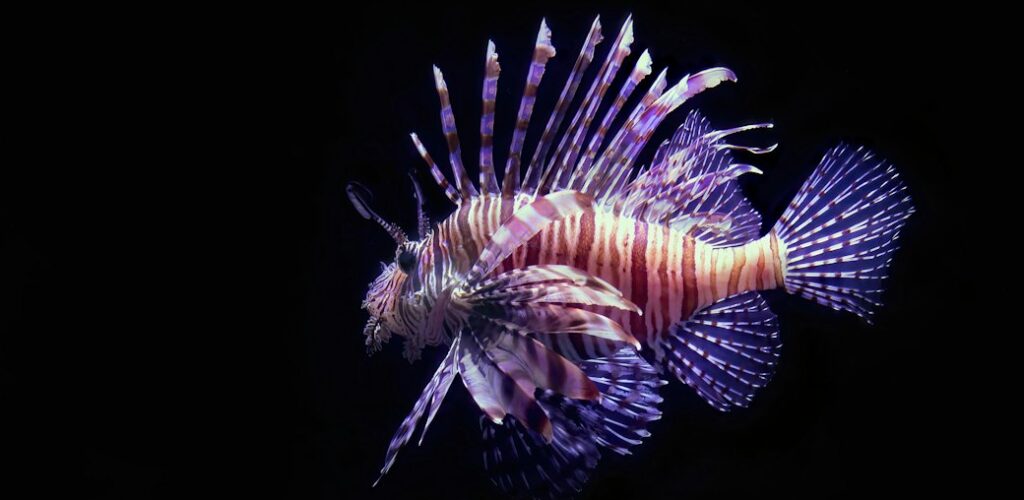
Nothing eats them. Lionfish have no natural predators in their invaded range. Studies show Atlantic predators avoid them, which isn’t surprising given the 18 venomous spines they carry: 13 along the dorsal fin, two on each pelvic fin, and one on the anal fin.
They eat almost anything. They swallow any fish or invertebrate that fits in their mouths, including the juvenile snappers, groupers, and grunts the reef depends on. In a well-known experiment, a single lionfish on a small patch reef cut the number of young native fish settling there by an average of 79% in five weeks.
They live everywhere. Lionfish have been found from 1 foot to 300 feet deep on hard bottom, mangrove, seagrass, coral, and artificial reefs like shipwrecks, and once an adult settles on good habitat it tends to stay, reaching densities of more than 200 adults per acre. NOAA National Ocean Service
How Florida fights back
Since no predator controls them, people do. FWC encourages removal, and the rules make it easy: no fishing license is required to take lionfish with a pole spear, Hawaiian sling, hand net, or gear designed specifically for lionfish, there’s no bag limit, and there’s no closed season. Florida Fish And Wildlife Conservation Commission
On top of that, Florida runs incentive programs. The Lionfish Challenge rewards divers by tiers for the number of fish they turn in, and Lionfish Removal and Awareness Day falls on the Saturday after Mother’s Day each year. Derbies run up and down the coast, with teams competing for cash prizes in a single day, which is the event Derby Day is modeled on.
Does it work? Locally, yes. Regular removals keep numbers down on individual reefs and give native fish room to recover. Regionally, no. Divers can only reach a fraction of lionfish habitat, and deep populations keep sending larvae back to shallow reefs. Removal is maintenance, not a cure.
Venomous, not poisonous
This distinction matters, and students mix it up constantly. Venom is injected; poison is eaten. A lionfish’s spines are grooved and covered with a skin-like sheath. When a spine goes in, the sheath tears back and the wound is exposed to venom glands along the spine. The flesh of a lionfish is not poisonous or venomous. Florida Fish And Wildlife Conservation Commission
A sting hurts. Pain comes on immediately, peaks around 60 to 90 minutes, and can last 6 to 12 hours, sometimes with swelling, headache, or nausea. First aid is to soak the wound in hot water that isn’t scalding, and to get medical care. No deaths from lionfish stings have been reported. Divers also need to be careful because lionfish don’t avoid people the way most fish do. edis.ifas.ufl.edu
That’s also why “eat them to beat them” works. The meat is white, mild, and flaky, and every restaurant that puts lionfish on the menu gives divers a reason to keep hunting.
What you can do
- Don’t release aquarium pets. The aquarium trade is the most likely source of the entire Atlantic invasion. One released fish started this.
- Order lionfish when you see it on a menu, and ask for it when you don’t.
- Report sightings to FWC so managers can track where lionfish are spreading.
- Join a derby or removal event if you dive, and learn safe handling first.
Controlling Invasive Lionfish Population – FAQs
Are lionfish dangerous to swimmers?
Their spines can sting, and lionfish don’t swim away from people, so give them space. Stings are painful but not deadly.
Do you need a license to hunt lionfish in Florida?
No fishing license is required when you use a pole spear, Hawaiian sling, hand net, or gear made specifically for lionfish, and there’s no bag limit.
Why can’t we just remove them all?
Divers can only work down to about 130 feet, and lionfish live far deeper. Those deep fish keep producing larvae that resettle shallow reefs.
Can you eat lionfish?
Yes. The venom is in the spines, not the meat. They are venomous but NOT poisonous! Handle them carefully and the fillets are excellent. Try the recipe below for a classic preparation of lionfish.
Pan-Seared Lionfish with Lemon-Garlic Butter
Thin, sweet white fillets in a lemon-garlic butter pan sauce. Start to finish in about 15 minutes, and every fillet is one less invader on the reef.
Ingredients
- 1½ lb skinless lionfish fillets (about 8 small fillets)
- ¾ tsp kosher salt
- ¼ tsp freshly ground black pepper
- ⅓ cup all-purpose flour
- 2 tbsp olive oil
- 3 tbsp butter
- 3 garlic cloves, thinly sliced
- 1 lemon, halved
- 2 tbsp chopped flat-leaf parsley
Method
- Dry and season the fish. Pat the fillets completely dry with paper towels, then season both sides with the salt and pepper. Dry fillets are what give you a golden crust instead of steamed fish.
- Dredge lightly. Spread the flour on a plate. Press each fillet into it and shake off the excess, so you have the thinnest possible coating.
- Heat the pan. Heat the olive oil in a large skillet over medium-high until it shimmers. Lay the fillets in without crowding, working in two batches if you need to.
- Sear the fillets. Cook undisturbed for about 2 minutes, until the edges turn opaque and the underside is golden, then flip once. The fillets are thin, so the second side needs only about a minute. Move them to a plate.
- Make the pan sauce. Lower the heat to medium. Add the butter and garlic and swirl until the garlic is fragrant and just barely golden, about 45 seconds. Don’t let it brown or it turns bitter.
- Finish and serve. Squeeze in the lemon juice and scrape up any browned bits. Stir in the parsley, spoon the sauce over the fish, and serve right away with rice or a green salad.
Is lionfish safe to eat? Yes. The venom is in the spines, never in the meat, and it has nothing to do with cooking. Any fillet you buy has already been trimmed. If you’re filleting your own, cut the spines off first with kitchen shears and wear puncture-resistant gloves.
Don’t overcook it. These fillets are thin. Pull them from the pan the moment they turn opaque.
No lionfish at your market? Ask a dive shop that runs lionfish trips, or check seafood counters carrying local catch. Hogfish, snapper, and grouper all work the same way in this recipe.